



Under European medical device regulation, an AI system that measures a wound and analyzes its tissue composition falls into the same regulatory family as an infusion pump or diagnostic imaging software: Class IIa. That means it cannot self-certify: an independent notified body must verify its safety, its clinical performance, and the manufacturer's quality system.
WoundTrack II, Pixacare's AI-powered chronic wound analysis module, has just obtained this certification, issued on March 16, 2026, by DNV Product Assurance AS (notified body no. 2460), under Annex IX of the EU MDR (Regulation (EU) 2017/745). To our knowledge, this is the first time a wound analysis AI solution has reached this milestone.
What a CE Class IIa marking actually means
The EU Medical Device Regulation (MDR, EU 2017/745) classifies healthcare software according to the risk it poses to the patient. Class I allows the manufacturer to self-certify, with no outside involvement. From Class IIa upward, a notified body must step in: it audits the device's technical documentation and the manufacturer's quality management system before the product can go to market.
Software that supports diagnosis, or assists clinical decision-making without directly driving it, generally falls into this Class IIa category. WoundTrack II illustrates the second case: it analyzes medical images to produce a measurement and a tissue classification, without making a diagnosis.
In practice, obtaining this marking means demonstrating, with clinical evidence, that the algorithm reliably and consistently does what it claims to do, and maintaining a certified quality system to guarantee that reliability over time, not just at the moment of the audit. These are, in fact, two distinct certifications that shouldn't be confused: Pixacare's quality management system is certified to ISO 13485:2016, while the CE Class IIa marking, carrying notified body number 2460, certifies WoundTrack II itself.
Why chronic wound care needs this
The scale of the issue is easy to grasp in a few figures:
- 1.2 million people live with a chronic wound in France (venous leg ulcers, arterial ulcers, pressure injuries, diabetic foot wounds), nearly 2 million when complex wounds are included, according to the SFFPC (French and Francophone Society for Wounds and Wound Healing).
- Treating them costs the French Social Security system alone around €1 billion a year.
- The EWMA valued the global wound care market at $18.5 billion in 2022, with a projected $30 billion by 2030.
Manual measurement, meanwhile, remains fairly unreliable: according to a study published in the Journal of the American College of Clinical Wound Specialists, it diverges significantly from reference digital planimetry, overestimating wound surface area by around 40%.
This is exactly the gap WoundTrack II is designed to address.
How WoundTrack II works
WoundTrack II is a Software as a Medical Device (SaMD) that automatically analyzes photographs of chronic wounds. It outlines the wound, calculates its surface area in cm², and identifies its tissue composition (granulation tissue, fibrin, necrosis).
Every segmentation stays under human supervision: the algorithm proposes an initial outline, the clinician corrects it if needed and validates it before the measurements are calculated. This hybrid approach combines the speed of automation with the reliability of clinical expertise.
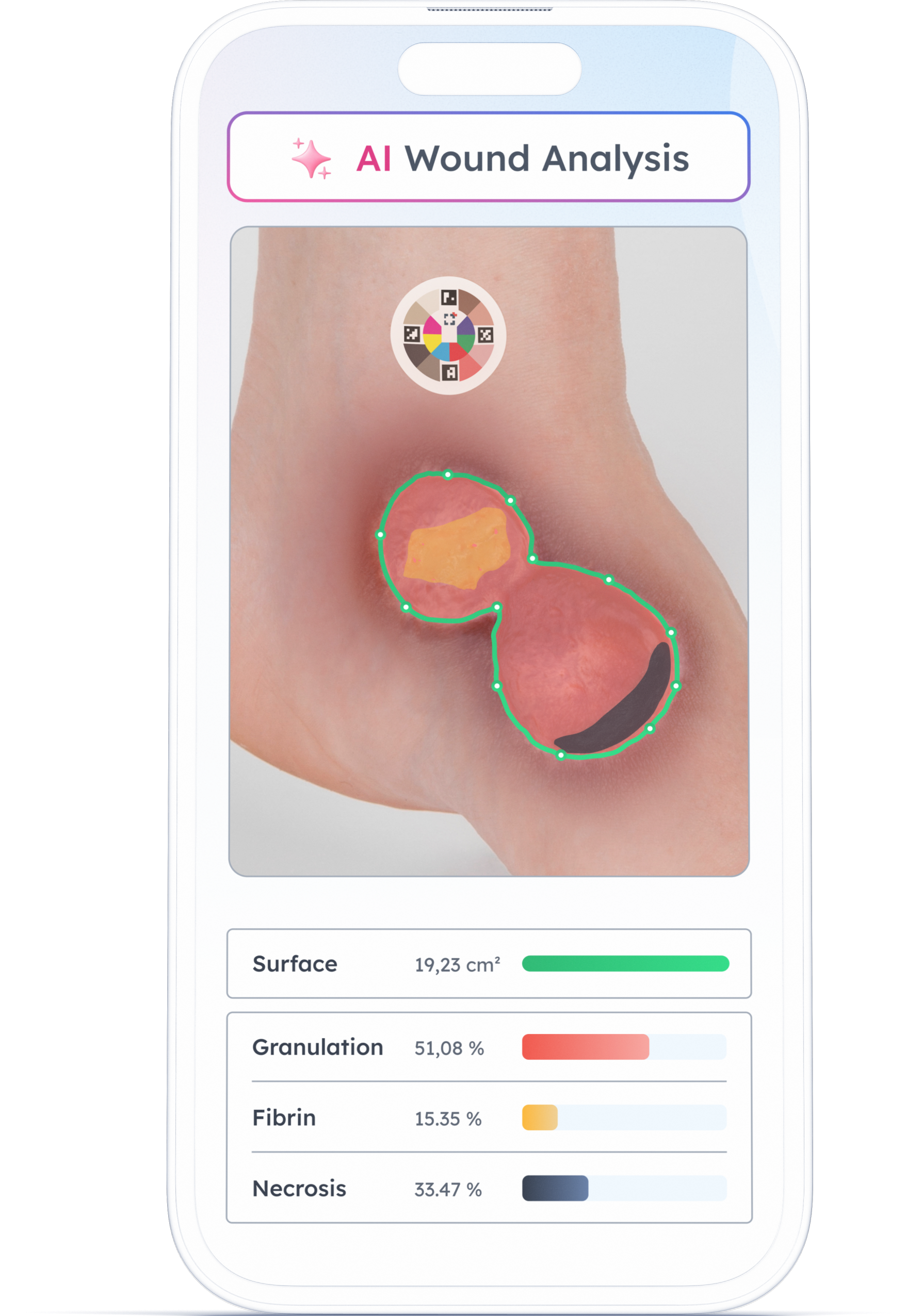
WoundTrack II is a clinical decision support tool: it does not replace a healthcare professional's clinical judgment. It works as an add-on module to Pixacare Application: photos taken through the platform are automatically analyzed, and the results appear directly in the clinician's interface, with no change to the working environment for facilities already using the platform.
"The MDR Class IIa certification reflects what we've championed from the start: artificial intelligence in the service of care, built on clinical evidence and evaluated to the same standards as any medical device. Our human-supervision approach illustrates this perfectly: the AI assists the clinician, it doesn't replace them."
Professor Frédéric Bodin, co-founder, Chief Scientific and Medical Officer of Pixacare, Head of the Plastic, Reconstructive and Maxillofacial Surgery Department at Strasbourg University Hospital
Three benefits of a reliable measurement
A standardized wound measurement doesn't only benefit the clinician performing it:
- For the patient: a poorly measured wound is a poorly monitored wound, with a higher risk of complications (infection, wound extension, delayed healing) and, for diabetic foot wounds, a risk of amputation.
- For healthcare facilities: some national regulatory frameworks are moving toward making reimbursement for wound care procedures conditional on precise, formalized documentation. Automating that documentation directly addresses this shift.
- For clinical research: a standardized, reproducible measurement is a prerequisite for reliable data in wound-healing clinical studies (evaluating dressings, creams, or other treatments).
A unique certification, four years in the making
Obtaining the CE Class IIa marking is the result of nearly four years of dialogue between Pixacare and DNV Product Assurance AS, its notified body. The challenge lay in the novelty of the field: having a wound-analysis AI evaluated as a genuine medical device was largely uncharted territory, which required both sides to adapt as they went.
To our knowledge, as of publication, WoundTrack II is the first wound analysis solution in the world to obtain this level of certification, and the only one authorized on the European market at Class IIa under the MDR.
"Until now, Pixacare let us ensure the traceability and monitoring of chronic wounds. Validating the AI modules takes things a step further: it enables reliable wound quantification, and therefore an optimized approach to care. By keeping the clinician in the loop to verify the algorithm, it makes the protocol more robust in complex cases and the most demanding imaging conditions, particularly on darker skin tones."
Dr. Guillaume Maxant, vascular surgeon at Haguenau Hospital, author of the Pixaire1 study on the evaluation of automated chronic wound surface measurement systems
What the certification means for care teams and decision-makers
For a healthcare facility, the CE Class IIa marking is more than an administrative formality: it's the guarantee that an independent third party has verified that the tool measures what it claims to measure, under its intended conditions of use. It is also increasingly becoming a direct purchasing criterion:
- In Switzerland, Cutempa Medical signed with Pixacare, explicitly citing the CE Class IIa marking as a condition of adoption.
- In Germany, Rodday Wundmanagement, one of the country's leading home wound care providers, signed on following the certification.
Pixacare is now deployed in more than 70 healthcare facilities across 6 countries, including Lille University Hospital, Gustave Roussy, and Liège University Hospital, monitoring more than 250,000 patients.
"Pixacare's vision starts from a simple observation: chronic wounds are a largely invisible health problem, yet their impact is considerable: on public finances, on caregivers' time, and on patients' quality of life. We firmly believe that digital technology and AI can help address this. But these tools cannot be mere software: they need to meet the highest standards of clinical performance and safety. That's the foundation we want to build on: becoming the global leader in AI-powered wound care management."
Matis Ringdal, CEO and co-founder of Pixacare
Learn more
The full details of this announcement (figures, official quotes, press contacts, and high-resolution visuals) are available in the press release:
Download the press release (PDF)

Références
- French National Authority for Health (HAS) and PMSI data, cited by the SFFPC: Chronic and complex wounds, nearly 2 million people affected
- European Wound Management Association (EWMA), Summary of Wound Prevalence, citing Fortune Business Insights
- Rogers et al., Wound Measurement Techniques: Comparing the Use of Ruler Method, 2D Imaging and 3D Scanner, Journal of the American College of Clinical Wound Specialists
- DNV Certificate No. C769484, issued March 16, 2026, valid until March 16, 2031, conformity assessed under Annex IX (Chapters I and III) of Regulation (EU) 2017/745
- Assurance Maladie (French national health insurance) and SFFPC, Chronic wounds: outpatient care, a practice support tool validated by the HAS
- Maxant et al., Evaluation of automated chronic wound surface measurement systems (the Pixaire1 study), medRxiv 2026.03.30.26344793


