



Remote monitoring of chronic wounds: how digital technology is transforming at-home patient follow-up
Every year in France, 700,000 older adults live with a chronic wound. A leg ulcer that won't heal. A diabetic foot wound that worsens between two appointments. Serious medical situations, often invisible, because the patient has gone home and no one sees what's happening.
It's in this gap between appointments that complications arise. That infections take hold. That emergency hospitalizations become unavoidable. That some amputations could have been prevented.
The human cost is immense. So is the economic cost: €1 billion per year for the French healthcare system.
The problem: discontinuous follow-up
Chronic wounds, whether venous or arterial leg ulcers or diabetic foot wounds, require regular, precise monitoring. In theory, the patient sees a clinician every two weeks. In practice, between appointment delays, transportation difficulties, and a shortage of specialists, follow-up is often more spaced out than it should be.
And even when appointments do happen, the clinician only has a snapshot: the state of the wound at that exact moment. They don't know what happened over the previous ten days. Did the wound improve, then regress? Did the patient follow the care plan? Did a sign of infection appear, then disappear?
This lack of continuity is at the heart of the problem.
Remote monitoring: moving from a snapshot to continuous follow-up
This is exactly what remote monitoring of chronic wounds solves.
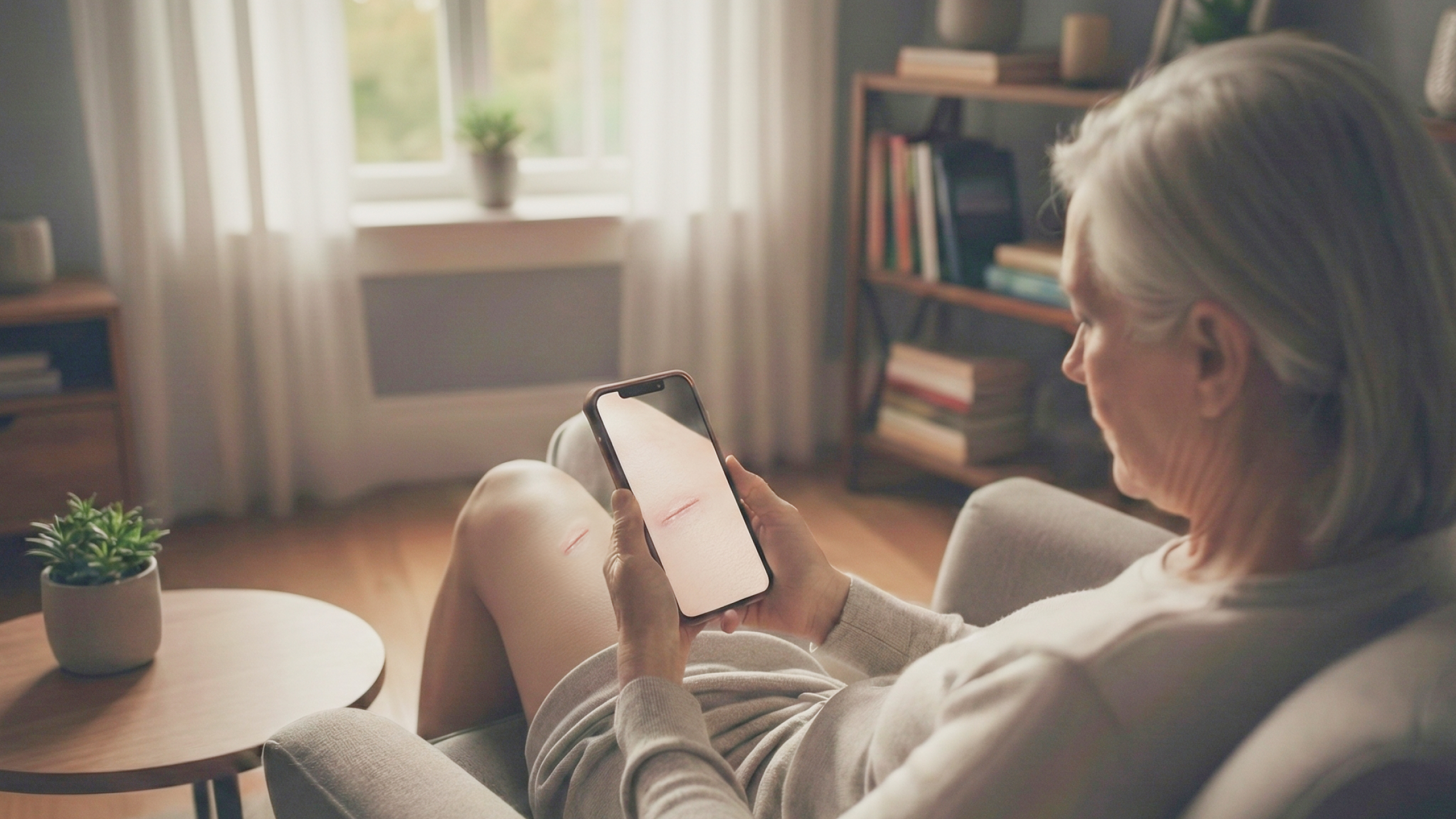
The principle is simple: several times a week, the patient receives a text message with a link. No app to install, no account to create. They take a photo of their wound and answer a few questions about the risk of complications. This is known as an ePRO (electronic Patient Reported Outcome), a follow-up questionnaire completed directly by the patient.
This data flows to the care team in real time. The physician or nurse can review how the wound has evolved over several weeks, receive notifications if an indicator is concerning, and step in immediately, without waiting for the next appointment.
It's the difference between a photograph and a film. Between a one-off check-in and continuous follow-up.
What the studies show
The first clinical results obtained with Pixacare, in a remote follow-up protocol run by a home care nurse, are significant:
- -35 days in wound healing time
- -55% in hospital visits
- -€1,600 in direct costs per patient
- 80% of patients satisfied
The PIXAPROM study also confirmed a crucial point: even older adults adopt the tool easily. Having no app to install, relying on a simple text message, and keeping the questionnaire short are key factors driving adoption.
The TELEWOUND study: validating at scale
Building on these results, Pixacare is now launching the TELEWOUND study, the largest evaluation of remote monitoring for chronic wounds ever conducted in France.
It is a pragmatic, randomized, multicenter clinical study involving 250 patients across 7 French hospitals: Bichat Hospital (AP-HP), Toulouse University Hospital, Strasbourg University Hospital, Besançon University Hospital, Angers University Hospital, Haguenau Hospital, and South Paris Île-de-France Hospital (CHSF). It is coordinated by Dr. Dured Dardari (CHSF), a recognized specialist in diabetic foot care.
The study has three complementary objectives:
- Demonstrate the clinical non-inferiority of remote monitoring compared to conventional follow-up
- Demonstrate its economic superiority (direct wound-related costs)
- Demonstrate its positive impact on patients' quality of life
The ultimate goal is clear: to give health authorities the evidence they need to consider reimbursement through France's national health insurance system for this approach, following the path already secured for five other chronic conditions under remote monitoring.
National recognition: France 2030
The TELEWOUND study was selected among the 17 winners of the France 2030 Grand Challenge "Digital Medical Devices for Healthy Aging," announced by Camille Galliard-Minier, Deputy Minister for Autonomy and Disabled Persons under the Minister of Health, at VivaTech. The program, backed by €8.68 million and run by Banque des Territoires, supports the most promising digital innovations for improving older adults' quality of life.
Being selected is both a scientific and institutional validation of the approach, and a responsibility: to demonstrate, under real-world conditions and at scale, that remote monitoring of chronic wounds delivers on its promise.
This project received state funding under the France 2030 plan.
Toward universal access to expert follow-up
Behind the figures and protocols lies a simple ambition: that every older adult, wherever they live, can benefit from expert follow-up for their wound, from home.
That distance, mobility difficulties, or a shortage of specialists no longer stand in the way of quality care. That digital technology finally becomes a concrete lever for healthy aging, not just a promise, but a clinically proven reality.
The TELEWOUND study is the step that makes this possible.
Pixacare is a medical photography and AI-powered chronic wound monitoring solution, deployed in more than 50 healthcare facilities in France, including around a third of French university hospitals, and used by more than 200,000 patients.


