



An Innovative Approach Combining Cold Plasma Therapy, Structured Documentation, Care Coordination, and Digital Measurement with Pixacare
At the Journées Cicatrisation 2026, the PLASANA GENESIS clinical study was presented as a novel approach to the management of chronic wounds. The study combines an emerging therapeutic technology, a collaborative care organization, and structured digital wound monitoring.
Within this framework, Pixacare is used as a digital solution for standardized wound documentation and clinical data collection throughout the study.
Study Overview
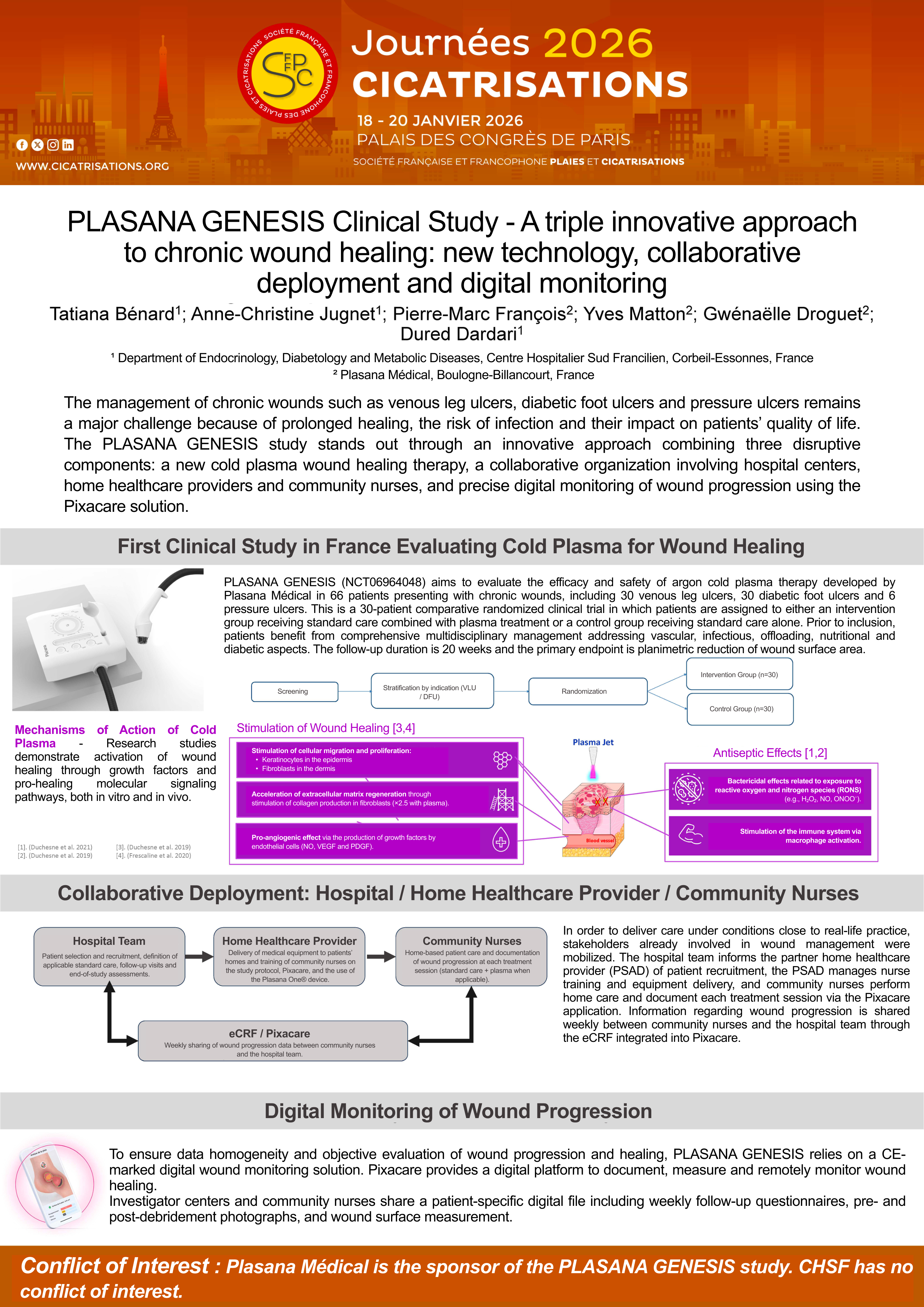
PLASANA GENESIS (NCT06964048) is a randomized controlled clinical trial designed to evaluate the efficacy and safety of argon cold plasma therapy, developed by Plasana Médical.
The study includes 66 patients with chronic wounds:
- 30 diabetic foot ulcers (DFU)
- 30 venous leg ulcers (VLU)
- 6 pressure ulcers (PU)
Participants are randomized into two groups:
- a control group, receiving standard care
- an intervention group, receiving standard care combined with cold plasma therapy
All patients first undergo comprehensive multidisciplinary management, including vascular assessment, infection control, offloading strategies, nutritional support, and diabetes management.
The follow-up period lasts 20 weeks, with a clearly defined primary endpoint: planimetric reduction in wound surface area.
The study is conducted by the Department of Endocrinology, Diabetology and Metabolic Diseases at Centre Hospitalier Sud Francilien, in collaboration with Plasana Médical, combining hospital expertise with technological innovation.
Cold Plasma: A Therapeutic Innovation
Argon cold plasma therapy is based on mechanisms described in the scientific literature and currently evaluated within the PLASANA GENESIS study.
Research highlights several biological effects:
- Antiseptic and bactericidal activity linked to reactive oxygen and nitrogen species (RONS)
- Immune modulation through macrophage activation
- Enhanced cell migration and proliferation
- Accelerated regeneration of the extracellular matrix
- Pro-angiogenic effects via growth factor production
PLASANA GENESIS is presented as the first clinical study conducted in France assessing cold plasma therapy for wound healing.
A Collaborative Care Model: Hospital–Community Coordination
To reflect real-world care conditions, the study is built on a collaborative care model involving:
- Hospital teams, responsible for patient selection, recruitment, definition of standard care, and scheduled follow-up visits
- Home healthcare providers, in charge of equipment delivery and training community nurses on the study protocol, Pixacare, and the use of the Plasana One® device
- Community nurses, who perform wound care at patients’ homes and document wound progression at each visit
This organization ensures continuity between hospital oversight and community-based care delivery.
Standardized Digital Wound Monitoring with Pixacare
Within the PLASANA GENESIS study, Pixacare supports structured, standardized wound follow-up across all care settings.
The objective is to ensure consistent, centralized data collection in a multi-stakeholder clinical environment.
Pixacare enables the creation of a shared digital patient record, accessible to authorized professionals involved in the study.
At each visit, community nurses document wound evolution directly in the application, including:
- Standardized clinical photographs
- Weekly structured follow-up questionnaires
- Automated wound surface measurement
Data are shared on a weekly basis with investigator centers, facilitating clinical oversight and strengthening hospital–community coordination.
PLASANA GENESIS illustrates the value of integrating therapeutic innovation, coordinated care pathways, and standardized digital monitoring in the management of chronic wounds. As the digital monitoring solution used in this study, Pixacare contributes to the standardization of wound data collection while supporting a collaborative model aligned with real-world clinical practice.
Références
- ClinicalTrials.gov. (2024). PLASANA GENESIS — Étude randomisée contrôlée sur le plasma froid d'argon dans les plaies chroniques. Identifiant NCT06964048. U.S. National Library of Medicine.
- Bekeschus S. et al. (2021). Medical gas plasma and its use in chronic wound management. Clinical Plasma Medicine. Elsevier.
- Bourke P. et al. (2017). The potential of cold plasma for safe and sustainable food production. Trends in Biotechnology.
- Haute Autorité de Santé. (2023). Prise en charge des plaies chroniques : recommandations de bonne pratique. HAS.
- European Wound Management Association. (2022). EWMA Document: Wound Bed Preparation in Clinical Practice. Journal of Wound Management.
- Wounds International. (2013). Best Practice Guidelines: Wound Management in Diabetic Foot Ulcers. Wounds International.
