



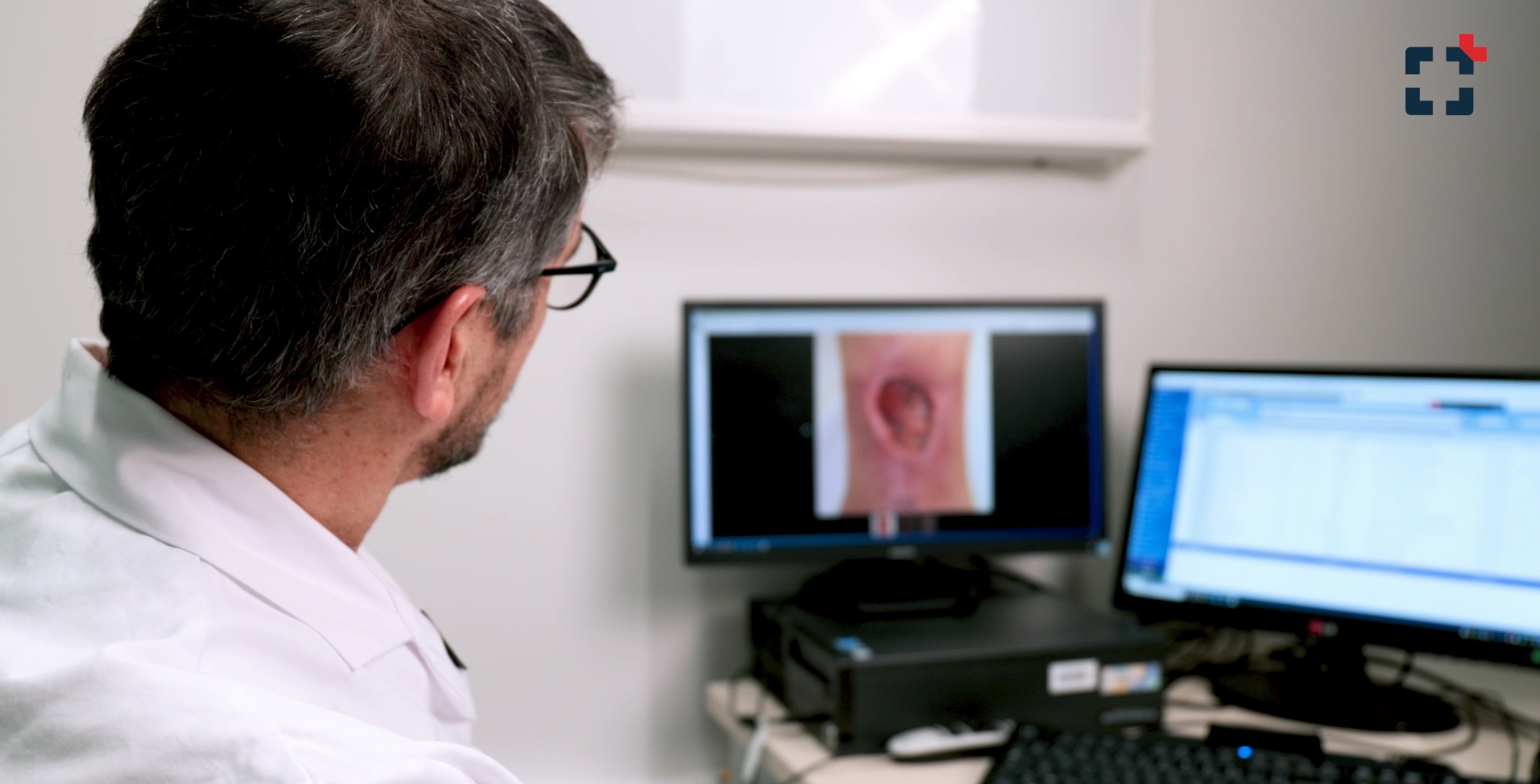
Video testimonial: the plastic surgery department at Strasbourg University Hospital shows how it uses Pixacare every day to manage clinical photos and follow patients after surgery.
At Strasbourg University Hospital, around twenty physicians in the plastic surgery department use Pixacare to manage their clinical photos. In this video, several members of the team explain how it fits into their daily practice, from the consultation room to the operating room.
Key takeaways:
- A shared, secure medical photo library the whole team can access
- Complete photo documentation, from preoperative to postoperative
- A patient's photo history in two clicks, saving real time in team meetings and appointments
- Automatic sync, even when there's no network in the hospital
A shared, secure medical photo library
Each physician takes their own photos, which are automatically centralized on the Pixacare server. Any practitioner in the department can then find every photo taken by the whole team, right from their computer.
"There are about twenty physicians in our department. All of them take photos and all of them use Pixacare: everything goes straight to the server, and I have every photo from the entire team on my computer. It's the only way to manage photos securely and as a team."
Prof. Frédéric Bodin, Head of the Department of Plastic, Reconstructive, Aesthetic and Maxillofacial Surgery, Strasbourg University Hospital
Complete follow-up, from preoperative to postoperative
In plastic surgery, preoperative photos have medicolegal value and document the patient's condition before surgery.
"We take preoperative photos, including an anterior view in plastic surgery, because they're medicolegal on the one hand, and because they give us an important preoperative baseline."
Dr. Léa Dibiase, plastic surgeon, Strasbourg University Hospital
Follow-up continues after surgery, at one week and then at three weeks, to track how the wound is healing. The patient record mirrors this workflow, with dedicated preoperative and postoperative sections, and makes it easy to ask colleagues for an opinion, sometimes right in the middle of a procedure. When there's no network in the hospital, photos sync automatically as soon as the connection is back.
Time saved in team meetings, appointments and research
A patient's full photo history is available in two clicks, which speeds up team meetings, appointments and keyword searches (type of surgery, technique used).
"Each patient's full photo history is available in two clicks, so it saves us a huge amount of time: everything is already organized, everything is automated, we don't have to do anything."
Prof. Frédéric Bodin
"It saves us as much time as possible in appointments, for our meetings and for our studies. We can search patients by keyword and instantly get the right patients' photos for a given type of surgery or technique. It really saves time."
Prof. Caroline Dissaux, Professor of Maxillofacial Surgery and plastic surgeon, Strasbourg University Hospital
The team sees these time savings as especially valuable in their day-to-day work.
A resident's perspective
In the outpatient clinic, residents follow patients with chronic wounds, abscesses or acute conditions.
"We see patients after an ER visit who come in with chronic wounds, abscesses, acute conditions: we photograph the wounds to follow how they evolve and heal. When I discovered Pixacare, I realized we could go much faster, and it's a lot more pleasant to spend that time with the patient than behind a screen."
Dr. Pierre Kara, plastic surgery resident, Strasbourg University Hospital
Prof. Frédéric Bodin, Head of the Department of Plastic, Reconstructive, Aesthetic and Maxillofacial Surgery at Strasbourg University Hospital and cofounder of Pixacare, sums up the spirit of the platform: "Pixacare is at the heart of patient management. It's our everyday tool."
Want to simplify how your department manages clinical photos? Discover Pixacare's medical photo library or book a demo.


